
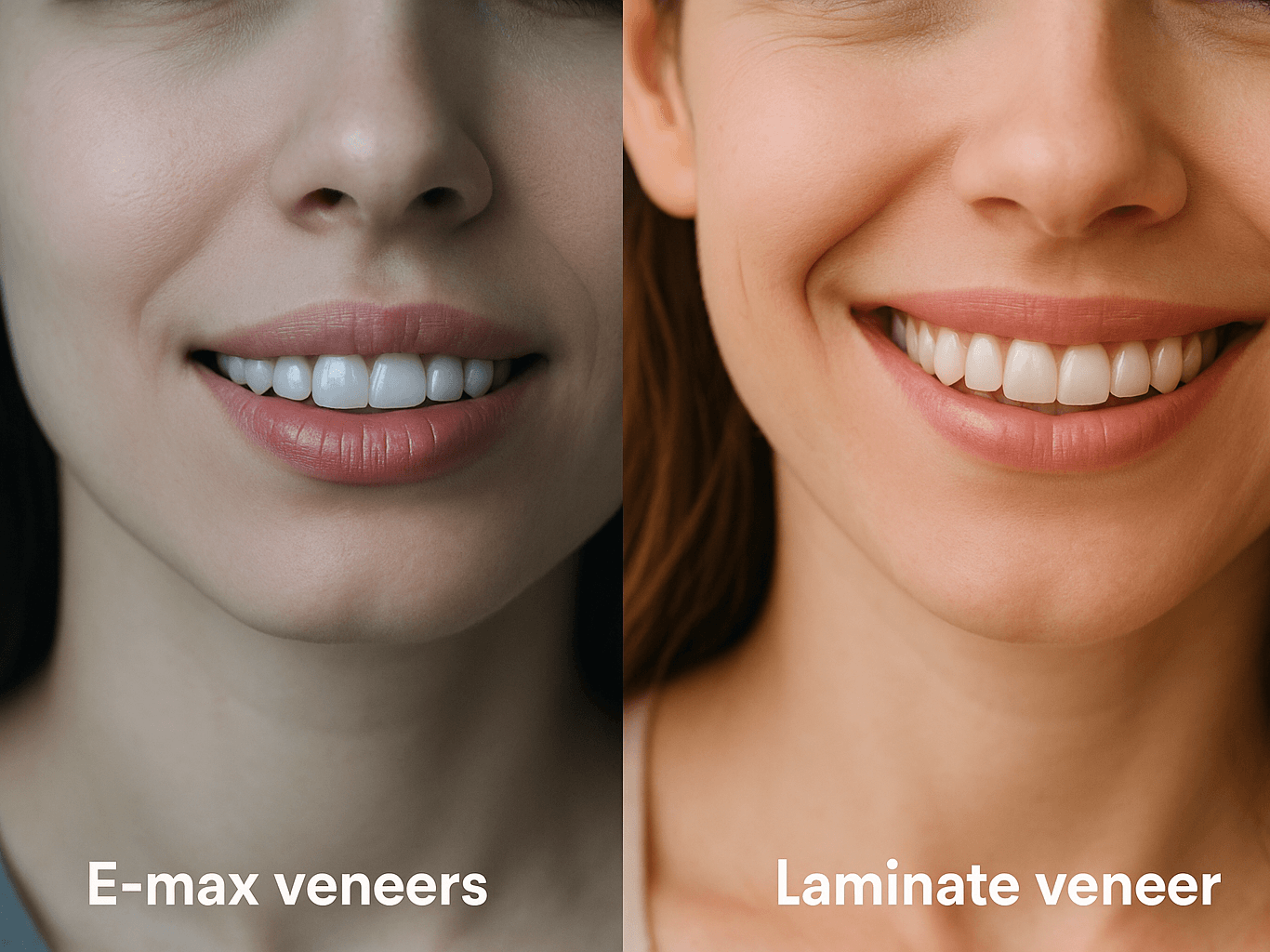
E-max veneers vs laminate veneers is one of the first comparisons people face when planning a smile makeover through cosmetic dentistry. Both reshape the appearance of the teeth, yet the ceramics behind them differ in strength, translucency, and expected lifespan. This guide breaks down what separates the two materials, how each holds up over time, and what the price difference reflects.
Anyone researching veneers quickly runs into a wall of terminology: e-max, laminate, composite, no-prep. We clear that up, covering what each material is made of, how it performs, and how the treatment unfolds from consultation to final polish.
E-Max Veneers vs Laminate Veneers: What Are They?
Laminate veneers and e-max veneers are not competing brands. They describe different manufacturing approaches within the broader category of porcelain veneers. Laminate veneers refer to the traditional wafer-thin porcelain shell technique, valued for its natural light reflection. E-max veneers are milled from lithium disilicate, a reinforced glass-ceramic material developed to combine strength and translucency in a way older porcelain formulas struggled to achieve. The distinction sits mainly in the raw material, not in the visual concept behind the treatment. A patient in the consultation chair usually cares about one thing: which option keeps its colour and shape the longest without compromising the appearance of the smile.
What Are Laminate Veneers?
Laminate veneers exist purely for aesthetic correction. Because they sit on the front surface of the tooth rather than replacing tooth structure, they resolve issues of colour, shape, and minor gaps without altering how a tooth functions. Someone with discoloured, chipped, or unevenly spaced teeth typically finds laminate veneers well suited to their needs.
The shells themselves are thin, yet a skilled dental technician bonds them precisely enough that the underlying tooth becomes invisible beneath the new surface. Patients rarely report discomfort during placement, since the process avoids deep tissue disruption.
One point worth remembering: veneers, laminate types included, may shift slightly in shade over the years, particularly with heavy coffee, tea, or wine consumption. Anyone who notices gradual darkening should raise it with their dentist rather than assume it is irreversible or normal.
What Are E-Max Veneers?
E-max veneers rely on a ceramic formulation designed to resist fracture while preserving a glass-like transparency. That transparency gives e-max restorations their close resemblance to enamel, especially near the edges of the tooth, where natural teeth show subtle light diffusion.
Because e-max veneers contain no metal substructure, light passes through them in a way that mimics real dentine more convincingly than older, opaque porcelain-fused-to-metal restorations. Most candidates with generally healthy teeth and gums qualify for the treatment, though a dentist still needs to confirm there is no underlying decay or gum disease before proceeding. A systematic review of 25 clinical studies covering 6,500 porcelain laminate veneers recorded a 10-year survival rate of 95.5%, which reflects how predictable modern ceramic veneers have become when placed correctly.
Benefits of E-Max and Laminate Veneers
Both e-max and standard laminate veneers share a common purpose: covering imperfections while preserving as much of the natural tooth as possible. The list below summarises the advantages patients tend to notice once treatment is complete.
- Minimal tooth preparation compared with crowns, which require far more structural reduction
- A natural, light-reflecting finish that avoids the flat, opaque look of older restorations
- Coverage for worn edges, discolouration, small chips, and minor spacing irregularities
- A meaningful boost in self-confidence tied to a more even, brighter smile
- Long-term durability when paired with sensible daily habits and routine dental visits
Digital smile design now plays a role in most reputable veneer cases, allowing the dentist to preview proportions and shade before any preparation begins. This planning stage reduces the guesswork that once made veneer outcomes harder to predict.
E-Max Veneers vs Laminate Veneers: Key Differences
The core difference between e-max veneers and laminate veneers is not conceptual. It comes down to material science. Laminate veneers describe the general porcelain shell technique, while e-max veneers use a specific lithium disilicate ceramic that many clinics now consider the more advanced choice within that category. In practice, e-max is often the material a dentist selects when a patient wants a laminate-style veneer with added fracture resistance.
Before any preparation begins, existing gum disease needs treatment. Placing veneers over inflamed or infected gum tissue undermines the long-term result, regardless of which ceramic is chosen. Both approaches involve conservative enamel removal, meaning the dentist shaves away only the minimal layer necessary to seat the shell flush against the tooth. Bonding then locks the veneer into place using a light-cured resin, a step that determines much of the restoration’s long-term strength.
Patients who grind their teeth at night, play contact sports, or have thinner enamel benefit from a frank conversation with their dentist about which ceramic better tolerates their specific bite forces.
E-Max vs Laminate Veneers Price: Cost Comparison
Cost is one of the biggest deciding factors, and it varies considerably depending on where the treatment takes place. Clinics in Turkey, including Smile Team in Antalya, have built a strong international reputation for offering e-max veneers at prices well below UK or Western European averages, without lowering the standard of the ceramic used. The table below outlines how the two destinations typically compare, without relying on fixed figures that shift from clinic to clinic and case to case.
| Factor | Turkey (e.g., Antalya) | United Kingdom |
| Price per tooth | Generally more affordable, with treatment packages that often bundle consultation, materials, and follow-up | Typically higher, and a separate consultation fee may apply |
| Material availability | Premium e-max and lithium disilicate ceramics are widely used | Availability and brand quality vary by clinic |
| Typical visit structure | Often completed within a single short trip of a few days | Usually spread across several separate appointments |
The final figure always depends on how many teeth need treatment, the complexity of the case, and the dental team performing the work. Booking a consultation remains the most reliable way to receive a tailored quote rather than relying on average price ranges found online.
E-Max and Laminate Veneer Treatment Process
Understanding the sequence of appointments helps set realistic expectations before committing to treatment. Most e-max and laminate veneer cases follow a similar structure, regardless of the clinic. The steps below outline what that sequence generally looks like.
- Consultation: the dentist examines the teeth and gums, discusses goals, and often uses digital smile design software to preview the outcome
- Minimal preparation: a thin layer of enamel is removed only where needed to accommodate the veneer’s thickness
- Impressions or digital scans: these guide the laboratory in fabricating veneers that match the desired shape, size, and shade
- Temporary veneers: worn briefly while the permanent restorations are milled and finished
- Bonding and final placement: the finished veneers are cemented using a resin that hardens under a curing light, followed by a bite check and polish
Local anaesthesia is typically used only if the preparation stage requires it, and most patients describe the overall experience as more comfortable than they anticipated.
Caring for Your E-Max and Laminate Veneers
Longevity depends heavily on daily habits rather than the ceramic alone. A veneer placed by a skilled dentist can still fail early if basic maintenance is ignored. The list below covers the habits that make the biggest difference.
- Brush twice daily and floss once daily to prevent staining near the gumline
- Avoid biting into hard foods, ice, or using teeth to open packaging
- Wear a nightguard if grinding or clenching has been diagnosed
- Attend routine dental check-ups so a dentist can catch early wear or debonding
- Limit prolonged exposure to strongly pigmented drinks such as red wine or dark tea
With consistent care, porcelain veneers commonly last 10 years or longer, with documented cases extending to two decades, before a replacement becomes necessary.
Choosing the Right Dental Clinic for E-Max and Laminate Veneers
The skill of the dental team affects the outcome as much as the ceramic itself. A well-executed e-max veneer in the hands of an inexperienced technician can still look artificial, while a modestly priced laminate veneer placed by a meticulous dentist can look flawless. Reputable clinics, whether in Antalya or London, generally offer a free or low-cost consultation before treatment begins, giving patients the chance to review before-and-after cases, ask about the specific ceramic brand used, and confirm aftercare support once they return home. Comparing at least two or three clinics, rather than choosing on price alone, tends to produce far more satisfying long-term results. Anyone still weighing e-max veneers vs laminate veneers benefits most from a personalised consultation that looks at their specific teeth, bite, and budget before a final decision is made.
You can read our previous article at https://smileteamturkey.com/blog/is-veneer-teeth-shaving-necessary/.
Frequently Asked Questions About E-Max vs Laminate Veneers
Can e-max veneers be whitened after placement?
No. Ceramic veneers do not respond to whitening gels the way natural enamel does, so the shade is fixed at the time of bonding. Anyone planning to whiten their natural teeth should do so before the veneer shade is selected.
Do veneers hurt the teeth underneath them?
When placed correctly, veneers do not damage the underlying tooth. The main consideration is that enamel removal is irreversible, so the treated tooth will always require a veneer or similar restoration going forward.
Can a single chipped veneer be repaired, or does the whole set need replacing?
A single damaged veneer can usually be replaced individually rather than redoing the entire set, provided the surrounding veneers remain intact and properly bonded.
Is it possible to switch from laminate veneers to e-max veneers later on?
Yes, in most cases. A dentist removes the existing veneer, reassesses the enamel, and fits a new e-max shell, though the tooth structure available for rebonding is evaluated first.
How soon after getting veneers can normal eating resume?
Most patients return to a normal diet within a day, though it is sensible to avoid very hard or sticky foods for the first week while the bond fully settles.