
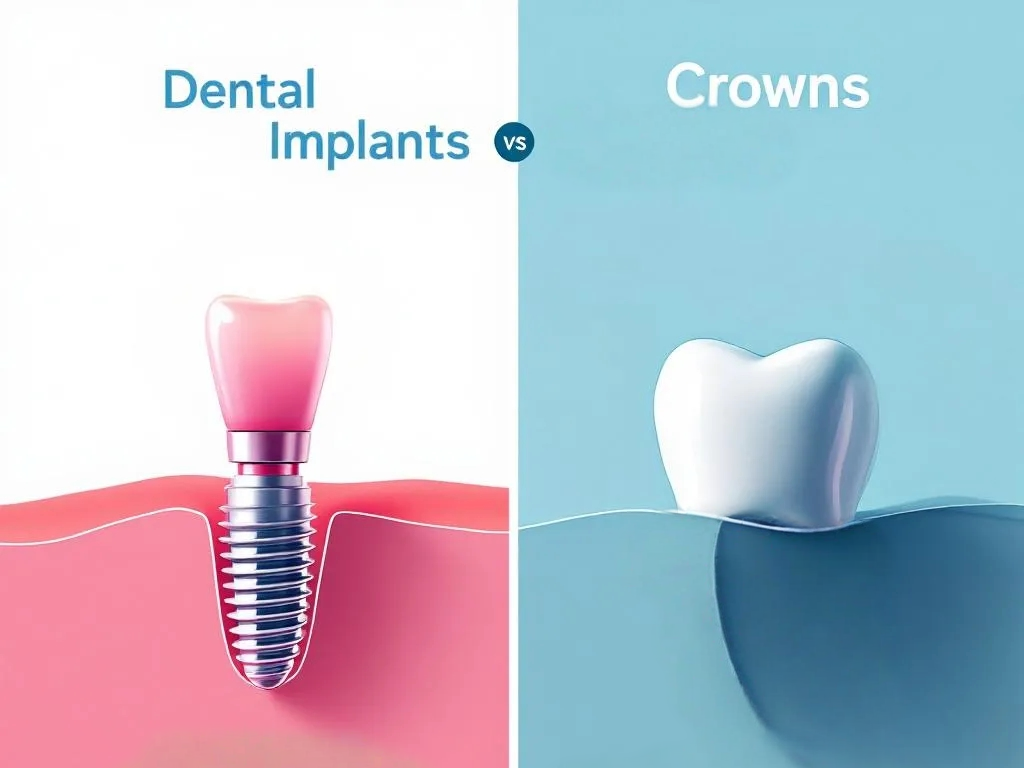
Missing or damaged teeth rarely announce themselves gently. A cracked molar or an empty gap in the smile line tends to raise one question fast: dental implants vs. crowns, and which one actually fits the situation. The sections below walk through how each restoration works, what a dentist typically weighs before recommending one over the other, and where cost, durability, and appearance separate the two paths.
What Is the Difference Between Dental Implants and Crowns?
The core distinction sits in what each restoration replaces. A dental implant replaces an entire tooth, root included, through a titanium post placed directly into the jawbone. A crown, by contrast, sits on top of a tooth that is still present, at least in part, covering and protecting what remains of the natural structure.
This difference shapes almost everything else that follows: who qualifies for each option, how long the treatment takes, what it costs, and how each one behaves over the following decade. A tooth that has broken but still has a healthy root is a different clinical situation from a tooth that has already been lost, and the two paths diverge accordingly.
Patients often assume the two options are interchangeable substitutes for “fixing a tooth,” yet they solve different problems. Recognizing which problem is present, a missing tooth or a damaged one, tends to narrow the decision considerably before cost or aesthetics even enter the conversation.
Dental Implants: A Comprehensive Solution for Tooth Replacement
Dental implants are custom-made artificial teeth surgically placed into the jaw. They function as a permanent replacement for people who have lost teeth due to decay, trauma, or gum disease. A titanium post, acting as an artificial root, is inserted into the jawbone, and an abutment plus a crown are later attached on top to complete the visible tooth.
Living with missing teeth affects more than appearance. Speech, chewing efficiency, and the alignment of neighboring teeth can all shift once a gap is left untreated. Replacing a missing tooth with an implant addresses the visible gap and the structural consequences that often follow, including the gradual loss of jawbone density beneath the empty socket.
Pros of Dental Implants
The advantages of implants center on how closely they mimic a natural tooth, including the root, rather than simply covering a gap. The list below summarizes the benefits most patients notice, both immediately and over the years that follow.
- Jawbone preservation: The titanium post stimulates the jaw the way a natural root once did, slowing the bone loss that otherwise follows tooth loss.
- Long-term durability: With consistent oral hygiene, implants are designed to last for decades rather than years.
- Natural look and feel: The crown attached to the implant is shaped and shaded to match surrounding teeth, and the fixed post allows normal biting force.
- Facial structure support: Because bone loss beneath a gap can lead to a sunken appearance over time, an implant’s stimulation of the jawbone helps maintain facial contours.
- No impact on neighboring teeth: Unlike a dental bridge, an implant does not rely on adjacent teeth for support.
Cons of Dental Implants
Implants also come with trade-offs that are worth weighing before committing to the procedure, mostly tied to the surgical nature of the treatment and the time it takes to heal. The points below outline what tends to concern patients most.
- Longer treatment timeline: Healing after extraction, the surgical placement itself, and the bone-to-implant fusion period (osseointegration) can together stretch across several months, with osseointegration alone commonly taking 3 to 6 months.
- Surgical requirement: The procedure is invasive and not automatically suitable for everyone, particularly people with certain bone density issues or uncontrolled chronic conditions.
- Higher upfront cost: The materials, surgical time, and specialist involvement generally make implants pricier than crowns at the outset.
- Healing dependent on individual biology: Smoking, diabetes, and bone quality can all influence how predictably the implant integrates.
Crowns: A Versatile Option for Dental Restoration
Crowns are a dental restoration used to treat and rebuild teeth that are damaged, broken, decayed, or structurally weakened, but still rooted in place. They are custom-made caps, available in ceramic, porcelain, metal, or porcelain-fused-to-metal, and are cemented over the remaining natural tooth structure.
A crown does not replace a missing tooth root; instead, it reinforces and protects a tooth that would otherwise be too fragile for normal biting force. Dentists commonly recommend crowns after large fillings, root canal treatment, or fractures that leave insufficient healthy enamel for a simple filling to hold.
Pros of Crowns
Crowns appeal mainly to patients who still have a natural tooth worth saving, since the treatment reinforces rather than replaces. The list below covers the reasons crowns remain a common recommendation.
- Lower cost relative to implants: Since no surgical placement or bone integration period is involved.
- Faster procedure: Most crown treatments require only one or two dental visits.
- Tooth preservation: A weakened tooth can often be saved rather than extracted.
- Improved appearance: Discoloration, chips, or irregular shape can be corrected with a well-matched crown.
- Broad material choice: Ceramic and porcelain options allow a close match to natural tooth color.
Cons of Crowns
A crown’s downsides mostly relate to what is happening underneath it, since the restoration depends on the health of the tooth it covers. The following points summarize the most common concerns.
- Limited lifespan: Most dental crowns last a decade or longer with good care, commonly 10 to 15 years, but they are not considered a permanent, lifetime solution the way a healthy natural tooth is.
- Sensitivity after placement: Temporary discomfort with hot or cold foods is common in the weeks following the procedure.
- Risk of loosening: A crown that is not perfectly fitted, or one exposed to prolonged wear, can loosen or detach.
- Underlying decay risk: If a crown becomes loose without the patient noticing, the tooth structure beneath it can begin to decay unseen.
Crown vs. Implant: Pros and Cons at a Glance
The table below brings together the main differences already covered, side by side, for a quick comparison of what each restoration involves, how long it typically takes, and what it tends to cost relative to the other.
| Factor | Dental Implant | Dental Crown |
| Replaces | Entire tooth, including root | Only the visible portion of an existing tooth |
| Requires surgery | Yes | No |
| Typical treatment time | Several months, including 3–6 months of osseointegration | One to two visits |
| Jawbone preservation | Yes | No |
| Average lifespan | Decades, with proper care | 10–15 years on average, sometimes longer |
| Relative cost | Higher upfront | Lower upfront |
| Best suited for | Missing teeth | Damaged but structurally present teeth |
Crowns or Implants for Front Teeth
Front teeth carry a different set of priorities than molars, since appearance and speech both depend heavily on this part of the smile. When a front tooth is missing entirely, an implant tends to be the restoration of choice, since it replaces the root and prevents the bone recession that would otherwise change the shape of the gumline and, eventually, the smile itself.
When a front tooth is still present but chipped, discolored, or weakened, a porcelain or all-ceramic crown often provides the closest match to natural translucency and light reflection, both of which matter more visibly at the front of the mouth than further back. Either option, when properly executed, is capable of blending seamlessly with surrounding teeth, though the decision usually comes down to whether the natural tooth root remains viable or has already been lost.
Comparing Dental Implants and Crowns: Factors to Consider
Choosing between the two rarely comes down to preference alone. A dentist’s clinical assessment, combined with the patient’s own priorities around cost, timeline, and long-term care, usually shapes the final decision.
A closer look at Smile Team Turkey’s previous article on implants versus dentures offers further context for patients weighing multiple tooth-replacement paths at once.
Suitability for Your Dental Condition
Dental implants require adequate jawbone density and healthy gums, since the titanium post depends on successful integration with surrounding bone. People with significant bone loss, certain autoimmune conditions, or uncontrolled diabetes may need additional evaluation, and sometimes bone grafting, before an implant becomes viable.
Crowns come with their own limitations. A tooth with too little remaining structure, extensive decay beneath the gumline, or a cracked root is often not a good candidate for a crown alone and may instead need extraction, a root canal, or, in some cases, an implant.
Implant and Crown Cost and Insurance Coverage
Cost differences between the two options are shaped largely by the complexity of treatment. Because implants are frequently classified as elective or cosmetic by insurers, coverage tends to be more limited, pushing more of the total implant and crown cost onto the patient directly. Crowns, particularly when tied to a documented medical need such as a fracture or post-root-canal restoration, are more commonly covered, at least in part, by dental insurance plans.
The total implant and crown cost also depends on materials chosen, the number of teeth involved, and whether additional procedures like bone grafting or sinus lifts are required beforehand. A conversation with both a dentist and an insurance provider tends to produce the clearest estimate for any individual case.
Durability and Maintenance
Dental implants generally outlast crowns, provided the implant integrates successfully and is cared for with regular brushing, flossing, and dental visits. Crowns, while durable, sit on a natural tooth that can still develop decay at the margins, meaning the crown’s lifespan is partly tied to the health of the tooth underneath it.
Both restorations benefit from the same daily habits: consistent brushing, flossing around the restoration site, and avoiding excessive force from teeth grinding or biting hard objects.
Aesthetic Considerations
Function matters most, but appearance is rarely a secondary concern for most patients. Modern ceramic and porcelain materials, used in both crowns and implant-supported restorations, are shaded and shaped to closely resemble surrounding natural teeth. Either restoration, when placed by an experienced dentist, is generally difficult to distinguish from a natural tooth in everyday conversation or a smile photo.
Choosing What’s Right for Your Smile
Missing teeth tend to favor implants; damaged but present teeth tend to favor crowns. A dentist’s evaluation remains the most reliable way to match the right restoration to the right tooth.
You can safely get all oral care services from Smile Team’s specialist dentists. You can prefer our clinic and have dental implant treatment in Turkey.
Ready to find out which option suits your smile? Get in touch with Smile Team Turkey for a personalized consultation and take the first step toward a fully restored smile.
Frequently Asked Questions About Dental Implants vs. Crowns
Can a dental implant fail after it has healed?
Implant failure after successful healing is uncommon but possible, usually linked to poor oral hygiene, gum disease around the implant (peri-implantitis), or excessive biting force from grinding. Regular dental checkups typically catch early warning signs before failure occurs.
Is it painful to get a crown placed?
Local anesthesia is used during crown placement, so the procedure itself is not painful. Mild sensitivity or tenderness for a few days afterward is common and usually resolves without intervention.
How many dental visits does a crown typically require?
Most crown treatments take one to two visits: one for preparing the tooth and taking impressions (or scanning, if a same-day CAD/CAM system is used), and a second for fitting the final crown, unless a same-day system allows completion in a single appointment.
Can a crown be placed over an existing dental implant?
Yes. In implant treatment, a crown is the final visible component attached to the abutment on top of the implant post, so the two are frequently used together rather than being mutually exclusive.
What happens if a crown falls off?
A crown that falls off should be kept safe, and a dentist should be seen promptly, since the exposed tooth structure underneath becomes vulnerable to decay and sensitivity until the crown is recemented or replaced.
Are implants a good option for older adults?
Age alone is not a disqualifying factor for implants. What matters more is bone density, general health, and gum condition, all of which a dentist evaluates regardless of a patient’s age before recommending treatment.