
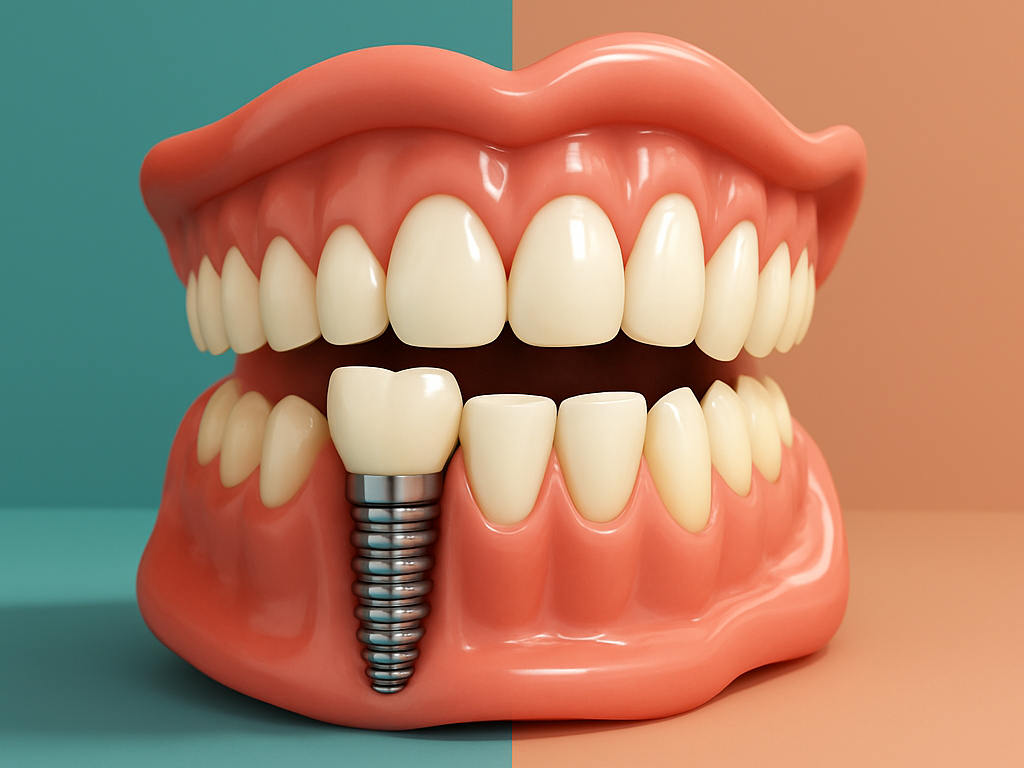
Losing a tooth changes more than a smile, and finding the right replacement often comes down to comparing dental implants vs. dentures side by side. This guide walks through how dental implants and removable dentures differ in comfort, durability, cost, and daily care, so the option that fits a particular mouth, budget, and lifestyle becomes clear before any decision is made with a dentist.
What Are Dental Implants and Dentures?
Before any pros-and-cons comparison makes sense, the two treatments deserve a clear definition, since “implant” and “denture” get used loosely, and patients often arrive at a consultation with a blended, inaccurate picture of both.
What Are Dental Implants?
A dental implant replaces a missing tooth from the root up. A titanium post gets surgically placed into the jawbone, where it fuses with living bone tissue through a process called osseointegration. Once healed, an abutment connects the post to a custom-made crown that sits above the gumline. The result functions as a fixed, permanent tooth rather than a removable device.
Because the titanium post takes over the job a natural tooth root once did, the surrounding jawbone continues receiving the pressure and stimulation it needs to stay dense. This mechanical detail explains much of why implants are frequently framed as the more biologically compatible of the two options.
What Are Dentures?
Dentures are removable prosthetic teeth, built to rest on the gums rather than anchor into bone. Two categories exist. Partial dentures fill gaps where some natural teeth remain, held in place with discreet metal or resin clasps. Complete dentures replace an entire arch, upper, lower, or both, for patients with no remaining teeth in that arch.
A denture’s fit depends heavily on the shape of the underlying gum ridge, which is why periodic adjustments, relines, or eventual replacement tend to be part of the ownership experience. A dentist typically examines the jaw, gum condition, and any remaining teeth before recommending which denture type suits the case.
Dental Implants vs. Dentures: Pros and Cons
Once the basic mechanics are clear, the dental implants vs. dentures pros and cons comparison usually comes down to four practical categories that shape daily comfort and long-term outcomes: appearance, comfort, durability, and maintenance.
Appearance and Aesthetics
Modern materials have narrowed the visual gap between the two options considerably. Porcelain and zirconia crowns on implants mimic the translucency of enamel with notable precision, while contemporary denture bases and acrylic teeth are shaded and shaped to match a patient’s remaining natural teeth or facial structure. A well-fitted denture and a well-placed implant can both pass a casual glance as natural teeth, and the difference tends to surface only in how each performs under closer, everyday use.
Comfort and Fit
This is where the two paths separate most clearly. Because an implant fuses directly with bone, it behaves like a rooted tooth, staying still while speaking or chewing. Dentures, resting on soft tissue rather than bone, rely on suction, adhesives, or clasps for stability. A well-made denture can feel secure, but changes in gum shape over months or years often loosen that fit, occasionally causing sore spots or a sensation of movement during meals.
Durability and Longevity
Longevity is one of the more measurable differences in the dental implants vs. dentures debate. With consistent oral hygiene and regular checkups, an implant’s titanium post can remain functional for many years, with large-scale clinical data placing overall implant survival rates above 97 percent. Dentures, built from acrylic and other materials that wear down with daily use, typically need replacement or a significant reline within five to ten years.
Maintenance and Care
Both restorations reward consistent care, though the routines differ. Dentures come out for cleaning, where a soft brush and a denture-specific solution keep them free of food residue and bacterial buildup, and soaking overnight helps preserve their shape. Implants, by contrast, get brushed and flossed in place, much like natural teeth, alongside routine dental visits to monitor the health of the surrounding gum and bone.
Dental Implants vs. Dentures Cost at a Glance
Cost is frequently the deciding factor, and it deserves an honest look rather than a vague estimate.
The table breaks down how dental implants vs. dentures cost compares across four practical categories:
| Factor | Dental Implants | Dentures |
| Upfront cost | Higher, reflecting surgical placement and custom crown work | Lower, since no surgery is involved and fabrication is faster |
| Typical lifespan | Around 20 years or longer with proper care | Roughly five to ten years before replacement or a major reline |
| Long-term cost | Often lower over time, due to fewer replacements | Recurring costs from relines, adhesives, and eventual remakes |
| Insurance coverage | Varies widely, often treated as elective | More commonly included in standard dental plans |
Figures vary by country, provider, and case complexity, but the pattern tends to hold fairly consistently across markets.
Neither figure tells the full story in isolation. A denture’s lower entry price can be offset by years of relines and replacements, while an implant’s higher initial investment often levels out once its longer lifespan is factored in. A dentist’s cost estimate, tailored to the specific case, remains the only reliable figure for planning purposes.
Advantages of Dental Implants
Several benefits set implants apart from other restorative options, and the list below highlights the ones that tend to matter most to patients prioritizing long-term stability over upfront savings.
- Natural look and feel: Since the root and crown are both replaced, implants function like natural teeth during eating, speaking, and everyday facial movement.
- Improved oral health: The titanium post stimulates the jawbone the way a natural root once did, helping slow the bone loss that typically follows tooth extraction.
- Long-term solution: With good oral hygiene, an implant can remain functional for decades, reducing the likelihood of repeat procedures.
- No impact on neighboring teeth: Unlike a bridge, an implant does not require reshaping adjacent healthy teeth for support.
Benefits of Dentures
Dentures remain a widely chosen option, particularly for patients seeking a faster, less invasive path to a restored smile. The list below covers the practical reasons dentures continue to suit a large share of patients.
- Non-invasive procedure: No surgery or healing period is required, which makes the process considerably more comfortable for anxious patients.
- Cost-effective solution: Among tooth-replacement options, dentures generally carry the lowest upfront price, with a complete set typically ranging from $1,000 to $3,500 per arch.
- Suitable for various oral health conditions: Patients with insufficient jawbone density, or those who cannot safely undergo surgery, frequently qualify for dentures when implants are not an option.
- Faster treatment process: From initial examination to final fitting, the process is typically shorter than the multi-stage implant timeline.
Which Option Fits Your Lifestyle?
The dental implants vs. dentures decision rarely hinges on a single factor. Jawbone density plays a role, since patients with significant bone loss may need grafting before an implant becomes viable, which adds time and cost to the process. Budget matters too, as does a patient’s tolerance for surgery versus a preference for a faster, reversible solution.
Age and general health enter the equation as well. A patient managing certain chronic conditions may be steered toward dentures simply because healing from implant surgery carries added risk. Meanwhile, someone missing just one or two teeth, with otherwise healthy bone, often finds an implant to be the more conservative long-term choice, since it avoids disturbing neighboring teeth altogether.
None of these factors substitute for a clinical exam. A dentist who has reviewed X-rays, bone density, and a patient’s full medical history remains best positioned to weigh dental implants vs. dentures for that specific case, rather than applying a generic recommendation.
A functioning, comfortable bite tends to matter more, in the end, than which option gets chosen, provided the decision rests on sound clinical guidance rather than price alone.
You can reach our previous article at https://smileteamturkey.com/blog/the-importance-of-dental-health-for-senior-citizens/
FAQ About Dental Implants vs Dentures
Can dental implants and dentures be combined?
Yes. Implant-supported (or “overdenture”) solutions anchor a removable denture to a small number of implants, offering more stability than a conventional denture while avoiding the cost of a full arch of individual implants.
How painful is getting a dental implant compared to fitting dentures?
Implant placement involves minor oral surgery under local anesthesia, with mild discomfort during healing that is typically managed with standard pain relief. Fitting dentures involves no surgery, though initial wear can cause soreness as gums adjust to the new appliance.
Do dentures affect speech more than implants?
Both can cause a brief speech adjustment period. Dentures, because they cover more of the palate and can shift slightly, tend to require a longer adaptation window than implants, which sit fixed in the jaw much like natural teeth.
Is bone loss reversible once dentures are worn for years?
Bone density lost after tooth extraction generally cannot be reversed by dentures, since dentures sit on the gum rather than stimulating the bone. Implants can help slow further bone loss once placed, but they do not restore bone that was already lost beforehand.
How often do dentures need to be replaced or adjusted?
Most dentures require relining or adjustment within a few years as the gum ridge changes shape, with full replacement typically recommended within five to ten years, depending on wear and fit.
Are dental implants safe for older adults?
Age alone rarely disqualifies a patient from implant treatment. What matters more is jawbone density, gum health, and overall medical history, all of which a dentist evaluates before recommending implants over dentures for a given case.