
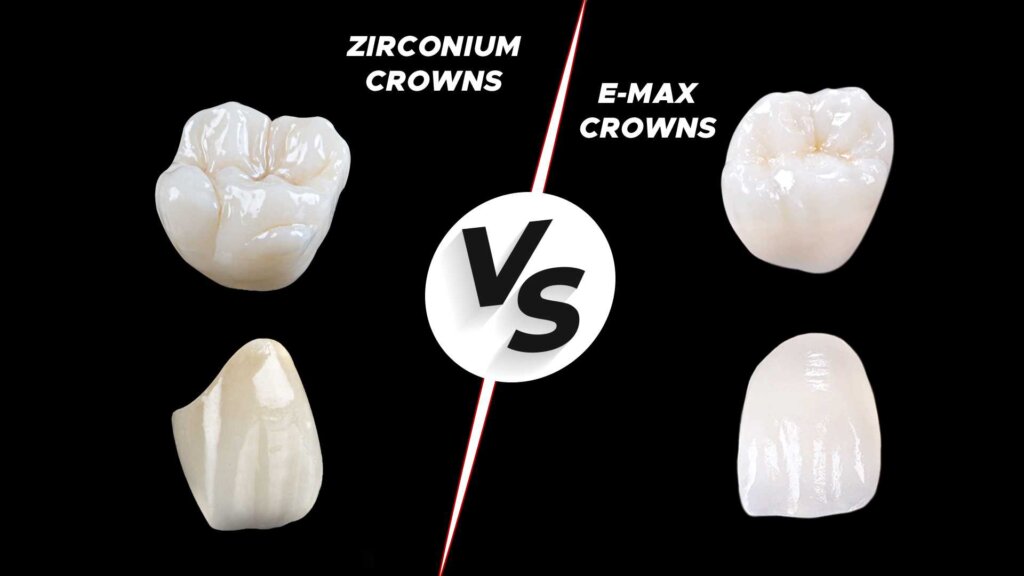
Patients comparing e-max crowns vs zirconium crowns are usually weighing two of today’s most dependable ceramic restorations, each with its own strengths and trade-offs. The sections below cover how each material is made, how it holds up to biting force, how natural it looks, and roughly what it costs, ending with a comparison table and answers to the questions patients ask most before deciding.
What Are E-max Crowns Made Of?
E-max crowns are pressed or milled from a single block of lithium disilicate, a glass-ceramic that has been used in restorative dentistry since the mid-2000s. Because the crown is carved from one solid piece rather than layered onto a metal or ceramic core, there is no substructure to show through the surface, no dark line at the gum margin, and no risk of the metal-related allergic reactions that older porcelain-fused-to-metal crowns occasionally caused.
The defining trait of lithium disilicate is translucency. Light behaves inside an e-max crown in a way that closely resembles how it behaves inside natural enamel, which is why dentists reach for this material most often on front teeth and premolars, where a restoration sits in full view every time a patient smiles or speaks.
Clinical research measuring flexural strength places lithium disilicate in the 350–400 MPa range, which is more than adequate for single crowns and short-span bridges in the esthetic zone, according to comparative research on CAD/CAM ceramic performance. E-max crowns may seem like a premium investment to some patients, but getting e-max crowns in Turkey tends to be a considerably more reasonable option than in Western Europe or North America, without any reduction in the quality of the material or the laboratory work behind it.
What Are Zirconia Crowns Made Of?
Zirconia crowns, still commonly searched for under the older term “zirconium crowns,” are milled from zirconium dioxide, a crystalline ceramic rather than a raw metal. The confusion is understandable, since zirconium itself is a metallic element, but the material that ends up in a patient’s mouth has been fully oxidized into a hard, biocompatible ceramic with no metallic properties left in it. That structural transformation is precisely what makes a zirconia crown resistant to cracking under the kind of biting force that would fracture older all-ceramic materials.
Because zirconia does not rely on a metal base, it avoids the grey shadow or dark line at the gumline that patients with porcelain-fused-to-metal crowns sometimes notice years after placement. Modern zirconia has also moved well past the opaque, chalky look of its earliest formulations; newer multilayered and translucent grades blend convincingly with surrounding teeth while still delivering flexural strength figures that run from roughly 800 MPa up to 1,200 MPa, depending on the generation of material used, as summarized in recent comparative fracture-resistance research. That strength margin is the main reason zirconia remains the material of choice for molars, bridges, and patients who grind or clench their teeth. Getting zirconium crowns in Turkey allows patients to access this higher-strength material at a fraction of what equivalent treatment costs elsewhere.
E-max vs Zirconia Crowns: Strength and Durability Compared
Strength is where the two materials diverge most clearly. Zirconia’s flexural strength roughly doubles or triples that of lithium disilicate, which is why dentists lean toward zirconia for back teeth that absorb the brunt of chewing forces, for longer bridges, and for patients whose bite places unusually high stress on a restoration. E-max, while less resistant to raw fracture force, still holds up remarkably well in the areas it was designed for. A ten-year independent clinical study following a specific full-strength zirconia product alongside e-max reported that 100% of the zirconia crowns and 94% of the e-max crowns in the study remained in clinical service after a decade, a survival gap narrow enough that, for a well-selected front-tooth case, e-max holds its own against its stronger rival.
Longevity estimates from broader dental literature tend to place zirconia crowns in the 15- to 20-year range with consistent oral hygiene, while e-max crowns are generally expected to last 10 to 15 years before a replacement becomes worth discussing. Neither figure is a guarantee; grinding habits, the position of the tooth in the mouth, and the skill of the dental laboratory all influence how a crown ages. What the numbers do confirm is that both materials sit comfortably ahead of the ceramic and metal-based crowns that dominated the market before either was introduced.
A separate five-year retrospective review of over a thousand restorations found a cumulative survival rate of 94.69 percent specifically for the glass-ceramic (lithium disilicate) crowns and fixed partial dentures in the study, with the small percentage of failures concentrated mostly around non-vital teeth and adhesive cementation errors rather than the material itself. This detail matters for patients weighing e-max against zirconia, since it suggests that clinical technique and case selection often influence outcomes as much as the raw mechanical properties of the ceramic. A crown chosen for the right tooth, cemented correctly, and paired with sensible bite habits tends to outperform published averages regardless of which of the two materials is used.
E-max vs Zirconia Crowns at a Glance
Some patients find it easier to weigh a decision once the technical details are laid out side by side rather than scattered across separate paragraphs. The table below condenses the material properties, appearance, and typical use cases discussed above into a single reference point.
| Feature | E-max Crown | Zirconia Crown |
| Base material | Lithium disilicate glass-ceramic | Zirconium dioxide ceramic |
| Flexural strength | Roughly 350–400 MPa | Roughly 800–1,200 MPa |
| Translucency | Very high, closest match to natural enamel | High in modern grades, slightly more opaque than e-max |
| Best suited for | Front teeth, premolars, single crowns, veneers | Molars, bridges, bruxism cases, implant restorations |
| Typical lifespan | 10 to 15 years | 15 to 20 years |
None of these figures change based on where the crown is placed, so the same comparison applies whether the treatment happens locally or, as covered further down, abroad in a country like Turkey.
Which Crown Looks More Natural? Aesthetics and Translucency
For patients whose main concern is how a restoration looks rather than how much force it can withstand, e-max still holds a slight edge. Its glass-ceramic structure transmits light the way enamel does, so the crown can appear to have subtle depth and internal glow rather than a flat, uniform whiteness. This is the reason lithium disilicate remains the default recommendation for a single front tooth crown, where the restoration sits next to natural teeth, and any mismatch in translucency becomes obvious under normal lighting.
Zirconia has closed much of that gap in recent years. Multilayered zirconia blocks now shift shade and translucency gradually from the neck of the crown to the biting edge, mimicking the natural gradient seen in real teeth. The result is a crown that, in the hands of an experienced ceramist, is difficult to distinguish from e-max at conversational distance, even if a dental professional examining the restoration under magnification can still tell the two materials apart. For patients restoring several visible teeth at once, this newer generation of zirconia offers a practical middle ground between strength and appearance.
Zirconia Emax Crown Price: What to Expect in Turkey
Cost is frequently the deciding factor once the clinical differences are understood, and it is also where Turkey’s dental sector has built its international reputation. Both e-max and zirconia crowns are considered premium restorations in most countries, largely because the materials themselves are costly to source and mill, and because both require a trained ceramist to finish the crown so it blends with surrounding teeth. Comparing emax vs zirconia price in Turkey against equivalent treatment in the UK, Germany, or the United States typically reveals a substantial cost advantage, without any compromise on the certification of the materials used.
Within Turkey itself, the zirconia emax crown price gap between the two materials tends to be modest, since both rely on similarly priced blocks and comparable laboratory processing time. The larger cost variable is usually the number of teeth being restored, the complexity of the case, and whether the treatment is bundled with other procedures during the same visit.
Overall, patients won’t find a dramatic difference between E-max crowns cost and Zirconium crowns cost, since premium material is used in both treatments. What ultimately shifts the final figure is the condition of the patient’s teeth and the number of units required to complete the smile.
Choosing Between E-max and Zirconia Crowns
Neither material is universally “better” in the way marketing copy sometimes implies. Both are used to fix damaged, missing, broken, and discolored teeth, and both rely on quality ceramics that offer long-lasting results when placed correctly. The more useful question is which properties matter most for a specific tooth, bite pattern, and cosmetic goal.
Situations Where E-max Crowns Tend to Fit Best
E-max tends to be the more sensible pick whenever appearance and light transmission outweigh the need for maximum fracture resistance:
- A single visible front tooth where translucency and light transmission matter most
- Patients with a normal bite and no history of teeth grinding
- Veneers or thin restorations where minimal tooth reduction is a priority
- Cases where matching the exact shade of neighboring natural teeth is the top concern
Situations Where Zirconia Crowns Tend to Fit Best
Zirconia tends to be the stronger match whenever the tooth in question absorbs heavier or more frequent biting force:
- Molars and premolars that absorb heavy chewing force
- Multi-unit bridges spanning several missing teeth
- Patients who clench or grind, where fracture resistance outweighs marginal translucency differences
- Crowns placed over dental implants, where structural strength supports long-term stability
Both e-max and zirconia crowns come from dependable, well-researched ceramic families, and choosing between them is less a matter of one being outdated and the other superior, and more a matter of matching material properties to the tooth being restored. A consultation that reviews bite force, the visibility of the tooth, and cosmetic priorities remains the most reliable path to the right decision, and that consultation can begin with a simple request to schedule your dental appointment.
You can read our previous post on https://smileteamturkey.com/blog/how-to-fix-gaps-between-teeth/
FAQ About E-max Crowns vs. Zirconium Crowns
Can e-max and zirconia crowns be whitened after placement?
No. Both materials are color-stable and do not respond to whitening gels the way natural enamel does. Any shade change needs to happen before the crown is fabricated, since the ceramic itself cannot be bleached once it is cemented in place.
Is a root canal always required before getting either type of crown?
Not necessarily. A root canal is only needed when the underlying tooth structure is decayed, infected, or has been significantly compromised. Many e-max and zirconia crowns are placed over healthy, vital teeth purely to restore shape, strength, or appearance.
How many dental visits does treatment usually take?
Traditional workflows typically involve two visits: one for shaping the tooth and taking impressions, and a second to fit the finished crown once the laboratory completes it. Clinics using in-house digital milling can sometimes shorten this to a single appointment.
Do e-max or zirconia crowns require any special aftercare?
Both materials are cared for like natural teeth, with regular brushing, flossing around the margins, and routine dental checkups. Patients who grind their teeth are often advised to wear a night guard regardless of which crown material was chosen, since even zirconia can wear down opposing natural teeth over time.
Can a crown be replaced with a different material later on?
Yes. If a patient later develops different priorities, such as needing more strength after a grinding habit emerges, an existing crown can be removed and replaced with a different material, provided the underlying tooth structure remains healthy enough to support a new restoration.