
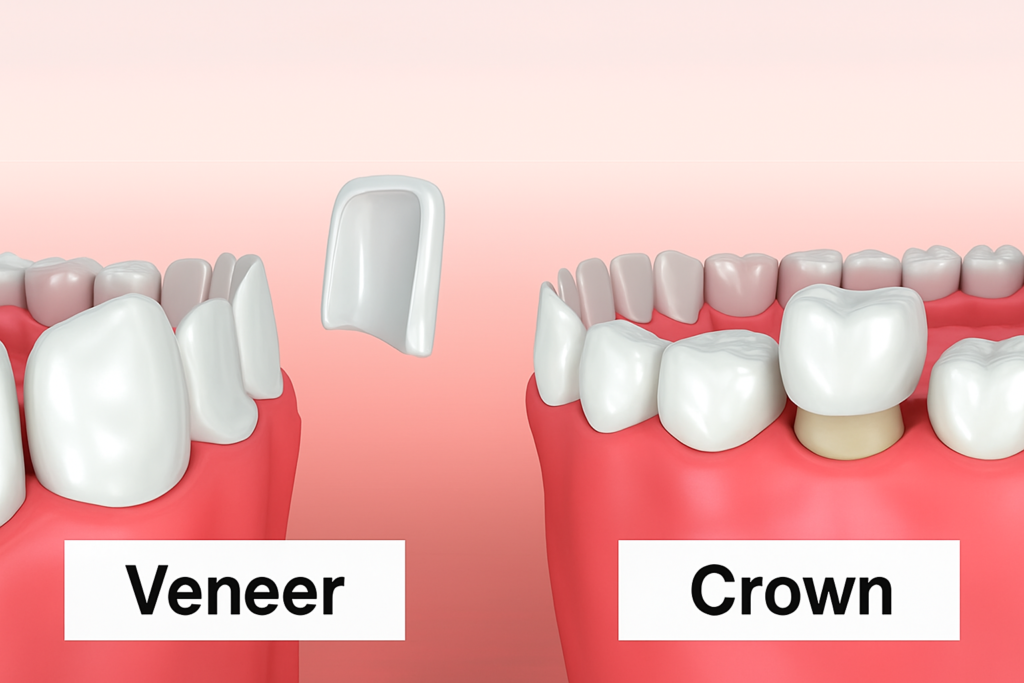
Deciding between front teeth crowns vs veneers becomes far easier once the two restorations are understood for what they actually do. One rebuilds a compromised tooth from every angle, while the other resurfaces only what the world sees. Both deliver a brighter, more even smile, yet they differ in preparation, longevity, cost, and candidacy, and those differences determine which option suits a particular tooth.
What Separates Front Teeth Crowns vs Veneers?
The simplest distinction sits in coverage. A veneer is a thin shell bonded to the visible front surface of a tooth, whereas a crown encases the entire tooth like a cap. That single structural difference explains almost every other contrast between them, from how much enamel comes away during preparation to whether dental insurance contributes anything toward the bill.
Purpose separates them further. Veneers and crowns both improve appearance, yet only one of them meaningfully reinforces a weakened tooth. Veneers are classified as cosmetic because they do not add structural strength, while crowns are restorative first and cosmetic second. The following points summarise where the two treatments genuinely diverge:
- Coverage: veneers resurface the front face of the tooth; crowns surround all surfaces.
- Tooth preparation: veneers call for a light reduction of enamel; crowns require reshaping the whole tooth.
- Primary function: veneers mask imperfections; crowns protect and rebuild damaged structure.
- Candidacy: veneers depend on sound enamel and a stable bite; crowns suit teeth that are cracked, heavily filled, or root-treated.
- Insurance: crowns are often partially reimbursed as a medical necessity; veneers are usually treated as elective.
Dental Veneers on Front Teeth
Veneers are custom shells, most commonly porcelain, bonded across the front of the tooth to conceal cracks, chips, crooked teeth, stubborn discolouration and minor spacing irregularities. Porcelain is favoured for front teeth because it transmits light in a way that mimics natural enamel, which keeps the result from looking flat or opaque under daylight.
What veneers cannot do matters just as much as what they can. They add no measurable strength to the tooth beneath, so the underlying structure has to be sound enough to carry the restoration on its own. The American Dental Association also notes that decay or gum disease requires treatment before veneers are placed, since covering an unhealthy tooth tends to compound the original problem rather than hide it.
Longevity sits in a predictable range when the bite cooperates. Dental veneers last between 10 and 15 years with appropriate care. Grinding habits, nail biting, and biting directly into hard foods shorten that span considerably, which is why candidacy assessment focuses so heavily on how the front teeth meet during function.
How Dental Veneers Are Placed
Treatment begins with radiographs and a discussion of shade, shape, and proportion. Before dental veneers are fabricated, the dentist reduces roughly half a millimetre of enamel from the facial surface, creating room for the shell to sit flush rather than bulky. An impression or digital scan then travels to the laboratory where the veneers are made.
At the second appointment, the veneers are tried in, checked for fit and margin accuracy, adjusted where needed, and bonded with a resin cement that is cured in place. Temporary veneers may bridge the interval between visits. Because enamel removal cannot be reversed, the preparation stage is the point at which the decision becomes permanent, and most of the planning effort is concentrated there.
Dental Crown Restoration for Front Teeth
Crowns are sometimes described informally as all-around veneers, since they cover every surface of the tooth. For front teeth, porcelain and porcelain-fused-to-metal remain common choices, alongside zirconia and pressed ceramic options that balance translucency with fracture resistance. The material decision rests on how much biting force the tooth absorbs and how much natural translucency the neighbouring teeth display.
A crown is advised when damage reaches beyond the cosmetic. Teeth with large existing fillings, significant fractures, substantial decay, or a completed root canal lose structural integrity, and a crown redistributes load across the whole tooth rather than leaving thin walls to absorb it. The damaged area is removed, the tooth is shaped, and the crown restores both contour and function in one restoration.
Durability reflects that protective role. The average lifespan of a dental crown is between five and 15 years, while attentive home care and regular checkups can extend service well beyond that. Crowns are also selected for cosmetic reasons when insufficient enamel remains to support a veneer reliably.
How Much Tooth Structure a Crown Requires
Crown preparation is considerably more invasive than veneer preparation, and that trade-off deserves plain acknowledgement. Rather than reducing one surface, the dentist reshapes the tooth circumferentially so the crown can seat over it with uniform thickness. The quantity removed depends on the crown material, since high-strength ceramics tolerate thinner walls than layered porcelain systems.
After shaping, an impression or scan is taken, and a temporary crown protects the prepared tooth. The permanent dental crowns are typically fitted one to two weeks later, once the laboratory work is complete. Fit, margin seal, shade, and bite contacts are verified before cementation, because a crown that sits even slightly high on the bite transmits uneven force to the tooth beneath it.
Veneers vs Crowns: Which Last Longer?
Published lifespans for the two restorations overlap substantially, so when front teeth crowns vs veneers are compared on durability alone, the answer depends less on the material and more on the tooth carrying it. Veneers bonded entirely to healthy enamel in a balanced bite often reach the upper end of their range, while a crown placed over a tooth with a questionable root may fail long before the crown itself wears out.
Clinical failure patterns also differ. Veneers tend to debond, chip at the incisal edge, or stain at the margin, and a chipped porcelain veneer usually calls for full replacement. Crowns more often fail because of what happens underneath, such as recurrent decay at the margin or fracture of the remaining root. The comparison below sets the two side by side across the factors patients weigh most:
| Factor | Crowns | Veneers |
| Benefits | Can prolong the life of teeth at risk | Can improve the smile to look better |
| Drawbacks | Greater intrusion | To be a good candidate, the patient has to have healthy gums and teeth |
| Indication | Structural improvement to tooth | Improves tooth appearance |
| Coverage | Encases the entire tooth | Covers the front surface only |
| Typical lifespan | Five to 15 years, longer with careful maintenance | Ten to 15 years with proper care |
| Cost | Slightly cheaper than veneers | Slightly more expensive than crowns |
Crown vs Veneer Cost and Insurance Coverage
Price shapes a great many front teeth crowns vs veneers decisions, and the figures move with several variables. Material selection, laboratory quality, the clinician’s experience, and the local cost of living all influence the final quotation, which is why per-tooth prices vary widely between practices and between countries.
The more consequential financial distinction lies in reimbursement rather than list price. Because a crown addresses structural damage, dental insurance frequently covers at least a portion of the treatment. Veneers are categorised as cosmetic, so insurers commonly decline them outright, leaving the full amount with the patient. A crown that looks more expensive on paper can therefore prove less expensive in practice.
Lifetime cost deserves attention alongside the initial invoice. A restoration replaced twice in 20 years carries a different total than one replaced once, and the cheaper option measured on day one is not always the cheaper option measured across two decades.
Veneers vs Crowns Pros and Cons at a Glance
Weighing veneers vs crowns pros and cons comes down to matching the restoration’s strengths against the condition of the specific tooth, which is where most front teeth crowns vs veneers questions are settled. Neither treatment outperforms the other universally, and the clinical examination usually points clearly toward one of them once enamel volume, bite forces, and gum health have been assessed. The considerations below reflect how that assessment tends to unfold:
- Veneers suit: Intact teeth with adequate enamel, mild discolouration resistant to whitening, small chips, minor rotations, and narrow gaps.
- Veneers struggle with: Heavy grinding, thin enamel, extensive existing restorations, and teeth that have lost significant structure.
- Crowns suit: Fractured or heavily filled teeth, root-treated teeth, severe discolouration from internal staining, and cases where enamel cannot support bonding.
- Crowns cost more in tooth structure: The preparation is irreversible and more extensive, which is a genuine clinical consideration rather than a technicality.
- Both require healthy foundations: Active decay and gum inflammation are treated before either restoration proceeds.
Veneers vs Crowns vs Bonding
Composite bonding occupies a useful middle ground that often goes unmentioned in a straight veneers vs crowns vs bonding comparison. Tooth-coloured resin is sculpted directly onto the tooth in a single visit, usually with minimal or no enamel reduction, which makes it the most conservative of the three and the easiest to revise later.
The trade-off appears over time. Bonding material typically lasts between three and 10 years before it needs touching up or replacing, and composite resin absorbs pigment from coffee, tea, and tobacco more readily than porcelain does. For a patient who wants a reversible trial of a new tooth shape, that shorter horizon can be an advantage rather than a flaw.
Choosing Between Front Teeth Crowns vs Veneers With Your Dentist
Every front teeth crowns vs veneers decision ultimately rests on an examination that no article can replicate. Enamel thickness, bite dynamics, gum health, and the condition of any existing restorations are assessed before a dental crown restoration or a veneer is recommended. Where the tooth is sound, and the concern is appearance alone, veneers usually prevail. Where structure has been lost, a crown protects what remains while delivering a natural-looking result.
Clarity about expectations, longevity, and cost before treatment begins tends to produce the most satisfying outcomes. Patients considering treatment abroad are welcome to contact Smile Team Turkey for an assessment and a treatment plan built around the condition of their own teeth.
You can read our previous article at https://smileteamturkey.com/teeth-whitening-turkey/.
Frequently Asked Questions About Front Teeth Crowns vs Veneers
Do most celebrities get veneers or front teeth crowns?
Cosmetic transformations in the public eye usually involve porcelain veneers, because most of those patients have structurally healthy teeth and want shape, shade, and alignment refined rather than rebuilt. Crowns appear in such cases only where a tooth has been fractured, root-treated, or heavily restored. Treatment plans are rarely disclosed publicly, so assumptions drawn from photographs tend to be unreliable.
Why do dentists advise against veneers in some cases?
Hesitation usually reflects candidacy rather than a dislike of the treatment. Thin enamel, untreated gum disease, significant crowding, and bruxism all reduce the predictability of bonded porcelain, and placing veneers over those conditions tends to shorten their service life. Enamel removal is also permanent, so a dentist may recommend orthodontics, whitening, or bonding first when a reversible route could achieve the same goal.
Is it good to get crowns on front teeth?
Crowns on front teeth are entirely appropriate when the tooth is weak, extensively restored, or discoloured from within, and modern ceramics reproduce the translucency that anterior teeth demand. Aesthetic results depend heavily on margin placement and gum health, since a visible crown edge at the gumline is the most common cosmetic complaint. Healthy teeth needing only surface refinement are generally served better by veneers.
Can a veneer be replaced with a crown later on?
Converting a veneer to a crown is possible and happens when a tooth fractures, develops decay, or requires root canal treatment after the veneer was placed. The sequence rarely runs in reverse, because the tooth reduction completed for a crown leaves too little structure for a veneer to bond against. That asymmetry is one reason conservative treatment is often recommended first.