
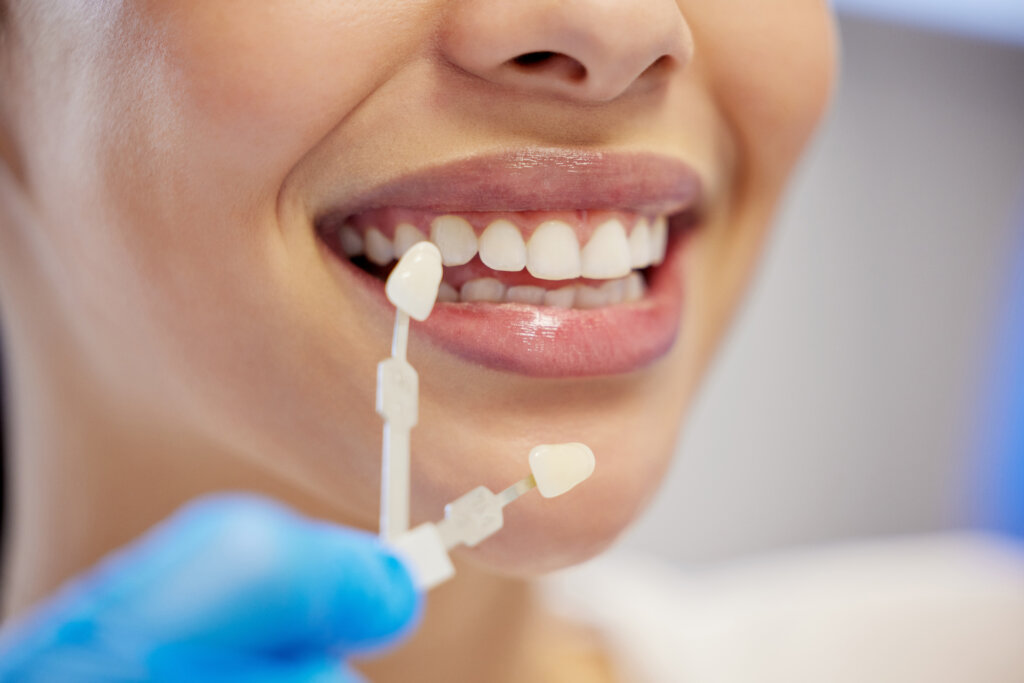
A chipped edge, a stubborn coffee stain, or a gap that catches the eye can quietly undermine how confident you feel when you smile. Dental veneers were designed to correct exactly this, and the debate over porcelain vs composite veneers is where most patients start their research. This guide walks through how each material performs on time, durability, appearance, and cost, so you can approach your dentist with realistic expectations.
What Are Porcelain and Composite Veneers?
Both porcelain and composite veneers are thin shells bonded to the front surface of a tooth to reshape its appearance. The material each is built from changes almost everything about the experience, from the chair time involved to how the final result ages.
Composite veneers are built from a tooth-colored resin, the same family of material dentists use for fillings and cosmetic bonding. Rather than being manufactured elsewhere, the resin is applied directly onto the tooth in thin layers, sculpted by hand, and hardened with a curing light after each layer. Once the shape and shade look right, the surface is polished to a natural sheen.
Porcelain veneers are pre-formed ceramic shells, custom-fabricated for each tooth in a dental laboratory based on impressions or digital scans. Because they are engineered outside the mouth under controlled conditions, porcelain veneers tend to reproduce the translucency and light reflection of natural enamel with more precision than a hand-sculpted material can.
Ceramic Veneers vs Composite Veneers: A Quick Material Comparison
“Ceramic veneers” and “porcelain veneers” are generally used interchangeably in cosmetic dentistry, since porcelain is a type of ceramic. The table below compares the two materials across the factors patients weigh most often before treatment, based on the details covered throughout this guide.
| Factor | Composite Veneers | Porcelain Veneers |
| Material | Tooth-colored resin | Layered dental ceramic |
| Chair time | Often a single visit | Typically two visits |
| Average lifespan | 5 to 7 years | 10 to 15 years |
| Stain resistance | Moderate, can discolor | High, resists staining |
| Repairability | Easy, in-office | Usually requires full replacement |
| Cost per tooth | More affordable | Noticeably higher |
| Reversibility | Can be removed with minimal tooth alteration | Considered a permanent commitment |
Comparing Porcelain vs Composite Veneers in Terms of Time
Treatment speed is often the first practical difference patients notice between the two materials. Composite veneers hold a clear advantage for anyone who wants results without multiple appointments. Because the resin is applied and shaped directly on the tooth, a dentist can often complete several composite veneers in a single visit, and the amount of enamel removed beforehand is minimal.
Porcelain veneers, by contrast, generally require two visits. During the first, the dentist prepares the tooth and takes an impression or digital scan that is sent to a dental laboratory, where a technician crafts the veneer by hand. The second visit is reserved for fitting and permanently bonding the finished piece. Modern digital workflows and same-day milling technology have shortened this timeline considerably compared to a decade ago, but composite veneers still win when speed is the priority.
The Durability of Porcelain vs Composite Veneers
Durability is where the two materials separate most sharply, and it is often the deciding factor once patients understand the trade-off. Porcelain is a notably harder, more wear-resistant material than composite resin. With consistent care, porcelain veneers typically last between 10 and 15 years, a range broadly consistent with the American Dental Association’s guidance that veneers generally last about a decade. Composite veneers have a shorter working life, usually lasting between five and seven years before they need replacing or refreshing.
There is an important difference in how each material is maintained once it starts to show wear:
- Porcelain veneers cannot be repaired. If one chips or cracks, the entire shell typically needs to be replaced rather than patched.
- Composite veneers can be repaired chairside. A chip or rough edge can often be smoothed or built back up with additional resin during a routine visit, without starting the process over.
That repairability does not necessarily mean composite is the lower-maintenance option overall. It simply changes how maintenance happens rather than whether it happens at all.
Aesthetic and Naturalness of Porcelain vs Composite Veneers
Appearance is usually the deciding factor for patients who plan to keep their veneers visible for years. Most cosmetic dentists consider porcelain the more convincing material for mimicking natural tooth enamel. Its layered structure scatters light in a way that closely resembles how real enamel behaves, giving porcelain veneers a depth that flatter, single-layer materials struggle to match.
Porcelain also holds color exceptionally well. A ceramic glaze applied during fabrication makes the surface highly resistant to staining from coffee, tea, red wine, or tobacco, meaning patients rarely need separate whitening treatments once porcelain veneers are placed.
Can You Whiten Composite Veneers?
This is one of the most common questions patients ask before committing to composite, and the honest answer is no. Whitening gels work by lifting stains out of natural enamel through a chemical bleaching reaction, and composite resin does not respond to that process the same way. In some cases, whitening products can actually roughen or dull the resin’s surface. If a composite veneer becomes discolored, the practical fix is polishing, resurfacing, or replacing it, not whitening it. This is one of the clearer trade-offs in the composite vs porcelain veneers pros and cons conversation, and it is worth factoring in before choosing composite purely for its lower upfront cost.
Porcelain’s one real aesthetic downside is that it is irreversible: once enamel is removed to accommodate the veneer, that tooth structure does not grow back. Composite, being additive and removable with comparatively little alteration to the tooth, remains the more conservative and reversible choice.
Composite vs Porcelain Veneers Price Compared
Cost is usually the first question patients ask, and composite has the clear edge upfront. Composite veneers are consistently the more affordable option per tooth, while porcelain veneers sit noticeably higher on the price scale in most markets.
That said, the sticker price only tells part of the story. Because composite veneers wear out faster, patients often repair or replace them more frequently, and those recurring costs accumulate over time. When the full lifespan of each material is factored in, the total cost of ownership between composite and porcelain often ends up closer than the initial price tags suggest. Location, the number of teeth being treated, and the experience of the dentist all shift these figures as well, so a consultation and written estimate remain the most reliable way to compare real costs.
Composite Veneers: Pros and Cons at a Glance
Weighing composite veneers on their own merits helps clarify who they suit best. The list below separates the practical advantages of composite from the trade-offs patients should expect over time.
Pros:
- Lower upfront cost per tooth
- Often completed in a single office visit
- Minimal enamel removal, making the process more conservative
- Easy to repair or adjust chairside
- Reversible with comparatively little impact on the natural tooth
Cons:
- Shorter average lifespan of 5 to 7 years
- More prone to staining over time
- Cannot be whitened once placed
- Softer material, more susceptible to chipping under heavy bite force
Are Composite Veneers Good? When They Make Sense
Composite veneers are a genuinely good option for the right patient. The question is not whether the material is inferior, but whether it fits your goals. The situations below are where composite tends to be the more sensible choice:
- Patients correcting one or two teeth rather than a full smile
- Anyone wanting to preview a cosmetic change before committing to a permanent solution
- Budget-conscious patients who understand they will likely need touch-ups or replacement within five to seven years
- Cases where minimal tooth alteration is a priority
Porcelain tends to be the stronger long-term investment for patients treating multiple visible teeth, prioritizing stain resistance, or wanting a single procedure they will not need to revisit for over a decade.
Making the Final Call
Neither material is objectively superior; each solves a different problem. A dentist can evaluate your bite, the condition of your existing enamel, and your cosmetic goals to recommend the option that will genuinely hold up for you, rather than the one that simply sounds better on paper.
You could walk into that consultation already knowing your own priorities, which makes the decision considerably easier. If budget and speed matter most, composite deserves a serious look. If longevity, stain resistance, and a closer match to natural enamel matter more, porcelain is generally worth the extra investment.
A chipped or discolored tooth does not have to be the reason you hold back a smile. Whether the path forward is porcelain vs composite veneers, both routes lead to the same outcome: a smile you are not tempted to hide.
You can read our previous post on https://smileteamturkey.com/blog/dental-care-turkey/
Frequently Asked Questions About Porcelain vs. Composite Veneers
How painful is getting porcelain or composite veneers?
Most patients feel little to no pain during placement. Composite veneers usually require no anesthesia at all, while porcelain veneers may involve a local anesthetic during the enamel-preparation step. Mild sensitivity to hot or cold for a few days afterward is normal and typically fades quickly.
Can veneers be removed if I change my mind?
Composite veneers can be removed relatively easily since minimal enamel is altered beforehand. Porcelain veneers are considered a permanent commitment because a thin layer of enamel is typically removed to fit them, and that enamel does not regenerate.
Do dental insurance plans cover veneers?
Veneers are almost always classified as a cosmetic procedure, so most dental insurance plans do not cover them. Some practices offer in-house financing or third-party payment plans to spread the cost over several months.
How do I care for veneers day to day?
Veneers do not require special products beyond consistent brushing, flossing, and routine dental checkups. Avoiding habits like biting fingernails, chewing ice, or using teeth as tools helps prevent chips in both materials, and a nightguard is often recommended for patients who grind their teeth.
Can veneers cause tooth decay underneath them?
Veneers themselves do not cause decay, but the natural tooth beneath still needs normal oral hygiene. Neglecting brushing and flossing around the margins of a veneer can allow decay to develop at the edges, so regular dental visits remain important even after treatment.
Is one veneer noticeably different from a full set?
A single, well-matched veneer can blend seamlessly with surrounding teeth when shade-matched carefully by an experienced dentist. Full sets are usually recommended when several visible teeth need correction, so the color and shape read as consistent across the smile.