
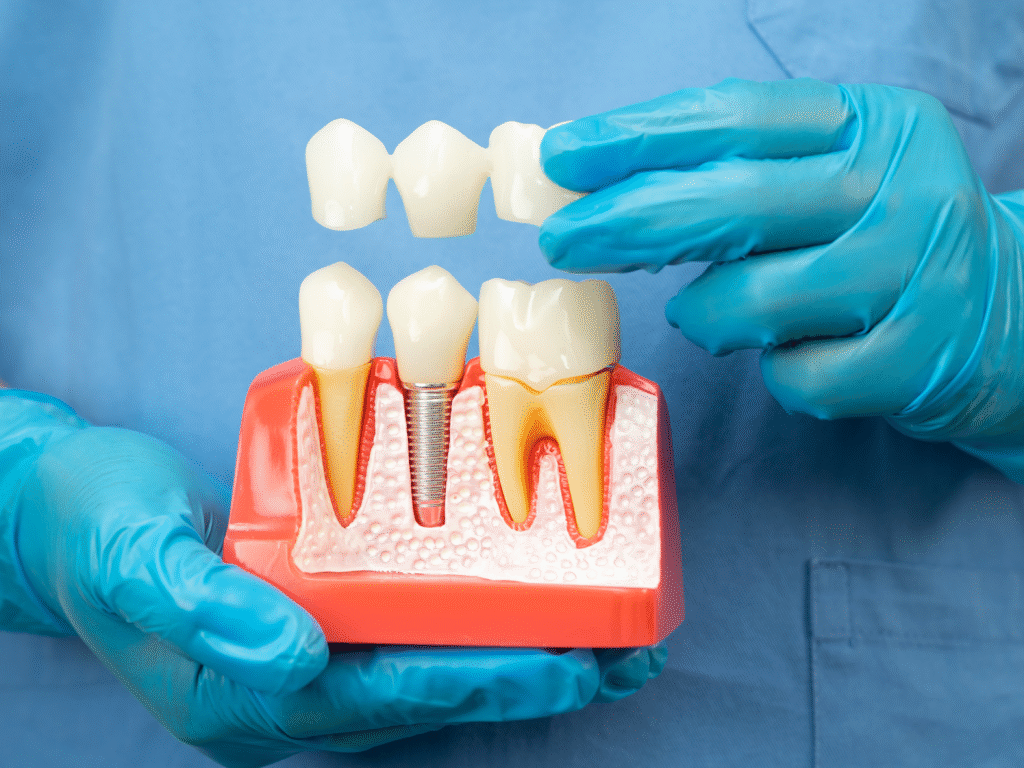
Losing an adult tooth sets off changes that reach past the gap itself, as bite pressure shifts, neighboring teeth drift, and the jawbone beneath slowly thins. Weighing a dental bridge vs. an implant decides how much of that progression gets halted. The sections below compare long-term cost, documented lifespans, effects on surrounding teeth and bone, treatment timelines, and which option tends to suit single gaps, front teeth, and wider spans.
What Separates a Dental Bridge From a Dental Implant?
Both restorations fill a visible gap, yet they solve different halves of the same problem. A bridge replaces what sits above the gumline. An implant replaces what sits below it. That single structural difference explains nearly every cost, lifespan, and maintenance distinction that follows, which is why our professional dental team begins each consultation with imaging of the bone and the neighboring teeth rather than with a price list.
How a Dental Bridge Restores the Gap
A bridge suspends an artificial tooth, called a pontic, between two supporting teeth that have been reshaped and crowned. Those supports carry the chewing load of three teeth across two roots. Traditional bridges use natural teeth as anchors, cantilever bridges rely on a single adjacent tooth, and Maryland bridges bond wings to the back surfaces of neighbors with minimal enamel reduction. Implant-supported bridges sit on titanium fixtures instead of natural teeth, which removes the drilling of healthy enamel from the equation entirely. The suitability of each type depends on how sound the surrounding teeth already are.
How a Dental Implant Replaces the Root
An implant works in three parts: a titanium post placed into the jawbone, an abutment that emerges through the gum, and a crown shaped to match surrounding enamel. The post fuses with living bone through osseointegration, a biological process that takes roughly three to six months and turns the fixture into a functional root. Neighboring teeth stay untouched. Chewing forces travel into the jawbone exactly as they did before the tooth was lost, which keeps that bone stimulated and dense.
Dental Bridge vs Implant Pros and Cons Side by Side
A direct comparison clarifies where each option earns its place. The table below sets out the practical differences patients notice across the first decade, and the lists that follow separate the genuine advantages from the trade-offs that deserve attention before treatment begins:
| Factor | Dental Bridge | Dental Implant |
| Total treatment time | Two to four weeks across two or three visits | Three to six months, allowing for bone healing |
| Effect on neighboring teeth | Enamel of adjacent teeth is reduced for crowns | Adjacent teeth remain untouched |
| Jawbone beneath the gap | Continues to resorb, as nothing stimulates it | Stimulated by the fixture through normal chewing |
| Typical lifespan | Five to fifteen years with disciplined care | Decades, with crown replacement more likely than fixture loss |
| Daily cleaning | Floss threaders or interdental brushes under the pontic | Brushing, flossing and an interdental brush |
| Initial cost | Lower at the outset | Higher at the outset |
| Consequence of failure | The whole unit is remade, affecting three teeth | The single site is addressed in isolation |
Reading those rows in isolation favors neither option. The honest summary of the advantages and the trade-offs looks like this:
- Bridges deliver a finished smile within weeks, which suits patients working to a deadline.
- Bridges reinforce adjacent teeth that already carry large fillings or weakened structure.
- Bridges require irreversible reshaping of teeth that may be perfectly healthy.
- Implants preserve bone volume and facial contour that a bridge leaves unsupported.
- Implants isolate risk, since a problem at one site does not compromise its neighbors.
- Implants call for sufficient bone, healthy gums, and patience through the healing months.
Tooth Bridge vs Implant Cost Over a Decade
The sticker price tells half the story. A bridge costs less on the day it is cemented, while an implant front-loads expense and then stays quiet for years. Measuring tooth bridge vs implant cost over ten or twenty years rather than over a single invoice often reverses the apparent winner, particularly once replacement cycles enter the calculation. A bridge replaced twice in twenty years rarely remains the economical choice.
Several variables move the figure in both directions, and clinics that quote without examining these are quoting on incomplete information:
- The number of teeth in the gap and the span the restoration must cover
- Material selection, from porcelain fused to metal through to full zirconia
- Preparatory treatment such as extraction, bone grafting, or sinus lifting
- The condition of the supporting teeth, where root canal work may be required first
- Laboratory standards and the implant system used, which differ widely between brands
Durability, Aesthetics and the Bone Underneath
Longevity data separates the two options more sharply than any other measure. Cleveland Clinic reports that the average lifespan of a dental bridge runs from five to fifteen years, extending further where hygiene and regular checks are maintained. Titanium fixtures perform differently: a systematic review of contemporary implant systems found a ten-year survival rate of 96.4% at implant level. Fixed prostheses carried on implants show comparable stability, with metal-ceramic implant-supported bridges surviving at 93.9% after ten years.
Appearance follows the same logic. An implant crown emerges from the gum along a natural contour, with the gum tissue cuffing it as it would a real tooth. Bridges start out convincing, though the pontic rests on the ridge rather than growing from it. As the bone beneath that ridge gradually resorbs, a shadow or small gap can appear under the artificial tooth, most noticeably in the smile zone. Several factors influence how long either result holds:
- Daily plaque control around the margins where restoration meets tissue
- Smoking, which measurably raises the risk of gum disease and implant complications
- Controlled or uncontrolled diabetes and its effect on healing
- Night-time grinding, which loads porcelain and abutments beyond their design intent
- Professional cleaning intervals and annual radiographic review
Treatment Steps, Comfort and Daily Maintenance
Patients weighing the two restorations frequently fear the surgery more than the cost. The procedure itself is modest: placement of a single fixture under local anesthesia usually takes under an hour, and most patients report pressure rather than pain during it. Bridge preparation involves no incision, though reducing two healthy teeth leaves them sensitive for a period and permanently dependent on crowns. Our overview of how implants work sets out the four stages from assessment through to the final crown.
Maintenance diverges after treatment ends. A bridge forms a sealed unit with no gap for floss to pass through, so cleaning beneath the pontic depends on threaders, superfloss or water flossers used consistently. Food debris left under a bridge feeds decay in the very teeth holding it up, which ranks among the main reasons bridges eventually fail. An implant is cleaned as a single tooth, with an interdental brush reaching the margins. Either restoration benefits from the habits covered in our guide to professional oral care.
Which Option Suits a Single Gap and the Smile Zone
Generalized comparisons lose value once the specific gap is identified. Position in the arch, the state of the neighbors, and the visibility of the site all shift the recommendation.
Dental Bridge vs Implant for One Tooth
A single missing tooth presents the clearest case in the whole comparison. The choice here comes down to whether two healthy neighbors should be drilled to solve a problem that sits between them. Where those neighbors are intact and unrestored, most clinicians consider that reduction difficult to justify. Where they already carry large fillings, failing crowns, or cracks, a bridge treats three problems in one restoration, and the reasoning changes entirely.
Dental Bridge vs Implant for Front Teeth
The smile zone raises the aesthetic stakes and the technical difficulty together. Bone in the upper front region is thinner, the gum line is fully visible, and any mismatch in contour or shade is immediately apparent. An implant placed with correct three-dimensional positioning, often alongside grafting, reproduces the emergence profile of a natural tooth most convincingly. A well-made bridge can look excellent from day one, though the ridge beneath it continues to flatten over the years. Planning in the anterior region consequently centers on how the result will look in a decade rather than at handover.
Dental Bridge vs Implant vs Denture vs Crown: Where Each Belongs
Four terms circulate in the same conversation while describing four different clinical situations. Separating them prevents comparisons that were never valid in the first place.
Comparing Fixed Options With Removable Dentures
Removable prosthetics enter the conversation once several teeth are missing. Partial dentures clasp onto remaining teeth and lift out for cleaning, which keeps cost and invasiveness low while asking the wearer to accept movement, bulk, and periodic relining as the ridge changes shape. Bridges and implants stay fixed. Implant-retained overdentures occupy a useful middle ground, where two to four fixtures anchor a removable prosthesis and restore chewing confidence without the cost of replacing every tooth individually.
Why a Crown Answers a Different Question
The crown belongs in a different category altogether, since it restores a tooth that still has a living root. Nothing is being replaced. Once the root is gone, a crown has nothing to cover, and the choice narrows back to a bridge, an implant, or a denture. A crown placed on an implant abutment, meanwhile, is simply the visible part of the implant restoration rather than a competing treatment.
Weighing a Dental Bridge vs Implant With Smile Team Turkey
Specialist opinion in our clinic rests on long-term performance rather than on initial outlay. Implants preserve bone, leave healthy teeth intact, and reward the months invested in healing with a restoration measured in decades. Bridges retain real clinical value where adjacent teeth are already compromised, where bone volume is insufficient, or where a stable result is needed quickly. The decisive factors are the condition of the neighboring teeth, the bone available at the site, and the patient’s long-term priorities, all of which emerge from examination rather than from an online comparison. Further information on treatment planning and implant options is available at Smile Team Turkey.
You can read our previous post on https://smileteamturkey.com/blog/dental-implant-in-just-4-steps/
Frequently Asked Questions About Dental Bridge vs Implant
Can a dental bridge be converted to an implant later?
Conversion is possible, though the timing matters. Years spent without root stimulation allow the ridge beneath the pontic to lose width and height, which frequently makes grafting necessary before a fixture can be placed. Patients considering an eventual switch benefit from raising it at the planning stage rather than after the bridge has been in service for a decade.
Is a bone graft always required before implant placement?
Grafting is needed only where the available bone cannot house the fixture securely. Three-dimensional imaging settles the question before surgery. Sites treated soon after extraction often retain enough volume, while long-standing gaps, upper molars close to the sinus, and thin anterior ridges are the situations where augmentation is most commonly recommended.
How soon after an extraction can each restoration be placed?
A bridge usually waits until the gum has healed and settled, typically a matter of weeks. Implant timing varies by protocol: some fixtures are placed into the socket immediately at extraction, while others follow after two to four months of soft tissue and bone healing. Infection at the site generally postpones both approaches.
Can implants and bridges be combined within the same mouth?
Combinations are routine. One quadrant may suit a bridge because the neighboring teeth already require crowns, while another is restored with implants to protect intact enamel. Joining a natural tooth and an implant within one fixed bridge is a separate matter, since the two move differently under load, and that design is approached with caution.
Which option suits patients who grind their teeth?
Bruxism loads any restoration beyond normal function and shortens the life of both. Implants can sustain heavy forces once integrated, though porcelain chipping and abutment screw loosening become more likely. Bridges face similar stress on their supporting teeth. A night guard is standard in both cases, and occlusal adjustment forms part of the treatment plan rather than an afterthought.