
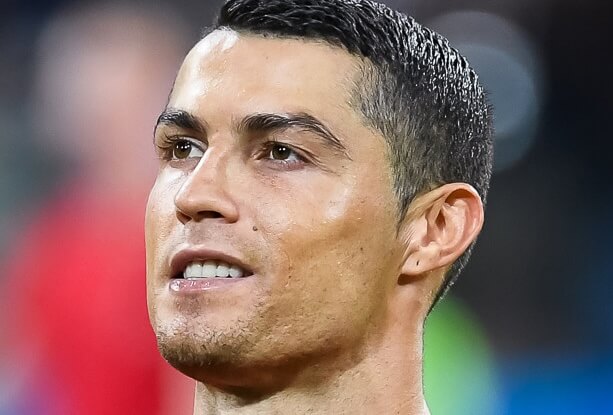
Анна Нэсси, CC BY-SA 3.0 GFDL, via Wikimedia Commons, Cropped
Two photographs twenty years apart tell the story that searches for Ronaldo teeth are really chasing: crowding, uneven shade and worn edges on one side, one of the most recognisable smiles in sport on the other. What follows separates careful observation from speculation, sets out the treatment stages capable of producing that result, and explains how a masculine smile keeps its own character.
Cristiano Ronaldo’s Teeth: Before and After
The change in Ronaldo’s teeth was gradual rather than sudden, and that detail matters more than any single image. Photographs from his Sporting Lisbon and early Manchester United years show a different dental picture from the one visible today, and no treatment record has ever been published, so everything beyond the images belongs to professional opinion rather than confirmed fact.
His Early Career Smile: Crowding, Shade and Edge Wear
Three features are observable in Ronaldo’s teeth before and after comparisons without any need for interpretation: mild crowding of the upper front teeth with slight rotation on the lateral incisors, a warmer and less uniform shade than today, and small irregularities along the incisal edges. None of that described a dental problem, which is why the later work reads as elective aesthetic dentistry rather than repair.
The Turning Point: When Did His Smile Change?
Coverage of the transformation names braces as its first stage, and HELLO! quotes a cosmetic dentist observing that one canine sat unusually close to the central teeth, which is precisely the crowding fixed appliances resolve. Other reporting places those braces in his early years, and the appliance appears in photographs from that period rather than any later one. By the Real Madrid period, the alignment reads as settled, and the shade more uniform, which points to restorative and whitening work layered onto a corrected foundation.
Ronaldo’s teeth timeline carries one lesson for anyone using it as a reference point. A result of that quality was built in stages across years rather than compressed into a single appointment, and the staging explains much of why it has held up under close photography.
What Dentists Say About His Current Smile
Cosmetic dentists commenting publicly converge on a combination rather than one procedure: alignment first, then ceramic restorations across the aesthetic zone, with whitening alongside. Restorations placed over rotated teeth need deeper reduction to sit flush, so correcting position first preserves enamel.
Caution belongs with any such reading. Shade, shape, and proportion can be assessed from Ronaldo’s teeth images, while the material used and the number of units involved cannot be.
The Treatments Behind a Ronaldo-Style Smile
Each element of a result like this solves a specific problem, and the problems are not interchangeable. Most Ronaldo teeth discussions skip that pairing and present a single procedure as the whole answer, so the mapping below sets out which concern belongs to which treatment before any of them is priced or scheduled.
- Crowding, rotation or a tilted arch: orthodontic alignment through fixed braces or clear aligners
- Shade, shape or minor spacing on sound teeth: porcelain veneers across the aesthetic zone
- Fractured, heavily filled or root-treated teeth: full-coverage crowns rather than veneers
- Generalised discolouration of natural teeth: professional whitening ahead of any ceramic work
- A gum line sitting low over short-looking teeth: gum contouring to restore proportion
- A missing tooth or a failed root: a dental implant carrying a single crown
- Most or all teeth lost in one jaw: full-arch implant protocols such as All-on-4 or All-on-6
Orthodontics First: Braces or Clear Aligners
Where crowding or rotation is significant, alignment precedes ceramic work for mechanical rather than cosmetic reasons. A rotated tooth sits further forward at one corner, so a veneer bonded straight onto it either stands proud of the arch or demands aggressive reduction of healthy enamel.
Skipping this stage is the most common compromise in rushed makeovers. A result that looks acceptable in the first week reveals itself later through thick restoration margins, a bulky gum line profile, and a bite that never quite settles.
Porcelain Veneers vs Zirconia Crowns
The choice between these restorations is decided by how much healthy tooth remains, not by which photographs are better. A veneer covers the front surface of a sound tooth, while a crown encircles one weakened by fracture, large fillings, or root canal treatment. The table compares both across the factors that shape a plan.
| Factor | Porcelain veneer | Zirconia crown |
| Main indication | Healthy tooth, shade or shape concerns | Weakened, heavily filled or root-treated tooth |
| Coverage | Front surface only | Entire tooth circumference |
| Tooth reduction | Minimal, facial surface only | Substantial, all surfaces |
| Aesthetics | Higher translucency, closer to enamel depth | Higher opacity, masks dark underlying tooth |
| Reversibility | Permanent, except for no-prep designs | Permanent in all cases |
| Typical lifespan | Around 10 to 15 years with maintenance | Comparable, stronger under heavy bite forces |
Lifespan figures follow Cleveland Clinic guidance, which puts dental veneers at an average of 10 to 15 years with proper care, and the same source notes that conventional veneers are not reversible while no-prep designs can be. Durability beyond that range depends far more on bite forces and night grinding than on the ceramic itself.
Professional Whitening and Gum Line Correction
Whitening lifts the shade of natural teeth, and because every ceramic unit is matched to its neighbours, whitening first sets the target shade rather than chasing it. The treatment affects natural enamel only, so any existing restorations keep their original colour and may need replacing to match afterwards.
Gum line correction addresses proportion instead of colour. Where the gum sits low over the upper teeth, the visible tooth reads short and square in a way no restoration can lengthen convincingly, and contouring the margin restores the height-to-width ratio. In male smile design, a longer visible tooth with a level gum line reads as structured rather than soft.
Dental Implants for Missing or Damaged Teeth
Tooth loss from impact is an occupational reality in contact sports, and it changes a plan fundamentally. A veneer or crown restores a tooth that is present, while an implant replaces the root of one that is absent, using a fixture placed in the jawbone to carry a crown.
The single versus full-arch distinction matters just as much. All-on-4 and All-on-6 protocols support a complete fixed arch on four or six angled implants for patients who have lost most of the teeth in a jaw, and bone volume assessed through 3D imaging decides which route is viable.
Getting a Natural Masculine Smile, Not Fake Teeth
What stops most men from booking cosmetic dentistry is not pain or cost but the prospect of an obviously artificial result. Its causes are design decisions made before any tooth is touched: units too uniform in length, too opaque, too rounded in outline, too bright for the face around them.
Tooth Shape and Proportion for Men
Male and female smile design diverge in ways subtle enough to pass unnoticed while deciding how a result reads. The square incisal edge visible in current Ronaldo teeth images, with less rounding at the corners, reads as masculine, and a flatter smile line supports the same impression.
Character lines complete the effect. Natural teeth carry faint vertical texture and minor asymmetry between the two sides of the arch, and ceramic reproducing both deflects the glassy uniformity that makes restorations recognisable.
Choosing a Realistic Shade
Shade choice is where a makeover either stays believable or tips over, and the deciding factor is the face rather than the shade guide. The brightest shades sit at the BL1 to BL2 end of the bleach range and only against very fair skin, while a BL2 to A1 range suits most male patients.
Age shifts the same calculation. Natural enamel warms and loses translucency across the decades, so a shade suited to twenty-five reads detached at fifty, and one or two steps warmer than the maximum keeps a result looking well maintained.
Red Flags When Booking Dental Treatment Abroad
Treatment abroad carries documented risk alongside its cost advantage, and the scale is on record. A British Dental Association survey of over 1,000 UK dentists found that 95% had examined patients treated overseas, 86% of those had treated resulting complications, and more than half reported repair costs above £1,000. The General Dental Council sets out what UK patients need to establish beforehand, and the signs below separate a planned treatment pathway like Ronaldo’s from a compressed sales process.
- No treatment plan issued in writing before preparation of any tooth begins
- A quoted price arriving without prior imaging or clinical assessment
- Crowns proposed across healthy teeth where veneers or alignment would suffice
- A schedule compressing full-arch implant work into a handful of days
- Guarantee terms naming no duration, no covered failures, and no claim process
- No named clinician, registration number, or verifiable qualification
- Pressure to confirm a booking during the first conversation
- No stated aftercare pathway for complications arising after the return home
What the Ronaldo Teeth Transformation Actually Demonstrates
The lasting value in studying Ronaldo’s teeth images lies less in the result than in the order the work was done. Alignment was corrected before anything was bonded over it, the shade was lifted before restorations were matched, and the sequence unfolded across years rather than days. That order separates a smile still photographed well after fifteen years from one needing rework after two, and it remains available to any patient whose plan is built around the same priorities rather than a fixed set of units.
Drawn to the balance in a smile like this rather than the shine alone? At Smile Team Turkey, our experienced dentists build each plan around your own facial proportions, bite, and goals instead of a single template, so the result reads as yours rather than borrowed. Our treatment options are set out across the site, and a consultation can be arranged whenever it suits you through our contact page.
Frequently Asked Questions About Ronaldo’s Teeth
Did Cristiano Ronaldo have veneers?
No treatment record has been published, so the accurate position is that the present appearance of Ronaldo’s teeth is consistent with ceramic restorations across the aesthetic zone. The shade uniformity, edge line, and proportion visible today are difficult to reach through whitening or alignment alone, which is the basis for that reading.
What did Ronaldo do to fix his teeth?
The staged sequence points to orthodontic alignment during his first Manchester United years, followed by restorative and whitening work afterwards. Reporting from that era describes fixed braces, while the restorative element remains a professional interpretation of the Ronaldo teeth photographs rather than documented history.
Read our previous blog post: “Selena Gomez Teeth: Veneers, Smile Transformation and Analysis”